For weeks before my diagnosis, I’d been suffering with a sore throat and a cold that seemed to never be helped by medicines or antibiotics. Eventually, my GP recommended I get a blood test. Thinking nothing of it, I went about my day until the very next morning I got a call from the hospital saying I needed to go in immediately.
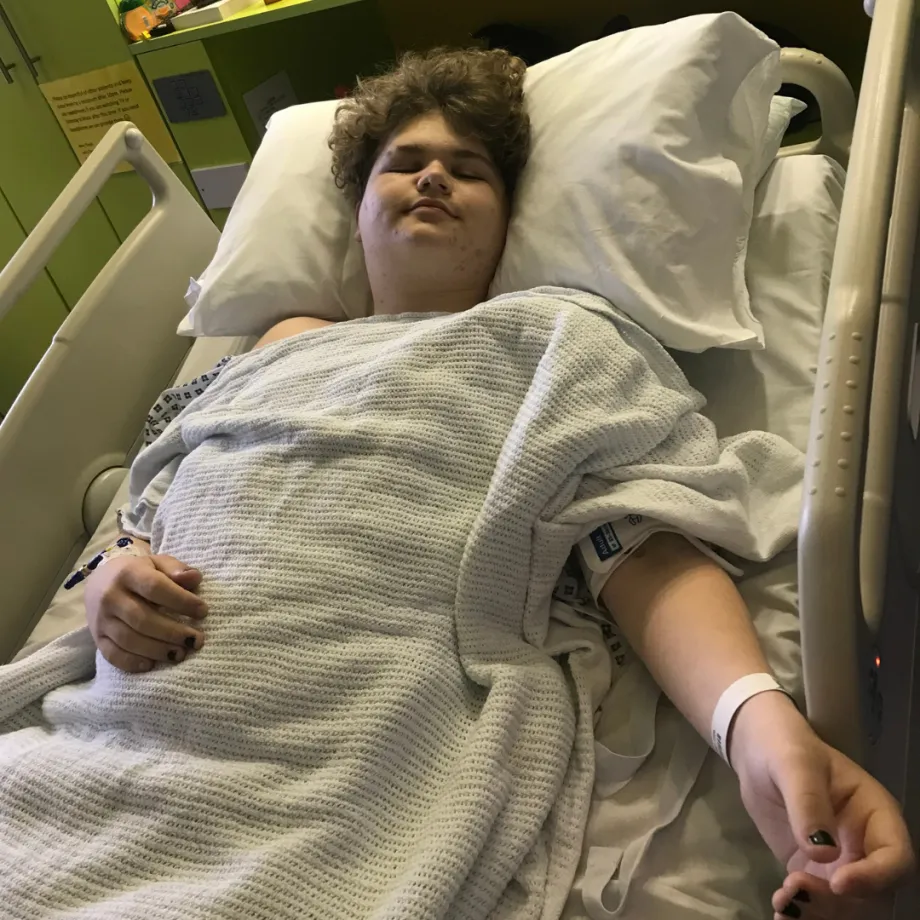
Jude during treatment
There, I got redirected to an oncology wing. As a 16-year-old, I had no idea what that even meant, but I quickly found out. When a bed became available at the Royal Marsden, I was quickly transported there to immediately start treatment for what they thought at the time was a more researched and understood type of leukaemia, acute lymphoblastic leukaemia (ALL). However, after looking into my bone marrow, they saw some faults that were missed in earlier blood tests which showed me having traces of both ALL and acute myeloid leukaemia, hence the very rare diagnosis of mixed-phenotype leukaemia.
How cancer and its treatment affected me
After many discussions, the team at the Marsden decided to go ahead with a course of chemo similar to ALL treatment, lasting 12 cycles and three-and-a-half years, with treatment ending in August 2024 when I was 19. Treatment took up many key years of my teenage life, when everyone else was discovering who they were, getting their first jobs, starting university, or learning to drive. For me, none of this was possible, and it really impacted me mentally.
I think everyone’s insecure in some way in their teenage years, but for a person with cancer, it’s almost always worse. My treatment greatly affected my appearance and, in turn, my self-worth. My loss of hair and the effects of the aggressive steroids I was on were the worst parts of treatment. The steroids, although they helped my body, made me rapidly put on weight. The rounding of my face, along with the baldness, really made me conscious of my appearance.
As someone who’d always struggled with self-image issues, this sent me into a depressive spiral. After reaching 16 stone at 17 years old, I started taking drastic measures, such as starving myself or self-harming, anything that made myself feel better, no matter how extreme. In my mind, this was bigger than the fact that I had cancer. All I could think about was that I was a mess.
In a couple months, I dropped six stone through dangerous practices like starving or purging myself, causing me to eventually reach out for help. I was carrying out the rest of my treatment at Brighton Hospital, where the paediatric oncology team referred me to a psychologist, therapist and dietitian, and eventually I received a diagnosis of atypical anorexia.
How I was supported
The team helped me realise that all this would pass just as quickly as it came on, and that there were ways to feel better about myself. I learnt what clothes made me feel good and I learnt how I wanted to present myself. That's how I discovered a love for fashion that has stayed with me to this day.
This only made me look forward to life after treatment, rather than thinking my life was over. Being someone that dresses alternatively, all I could think about was the tattoos, piercings and crazy hairstyles I’d be able to get once it was all over. For the meantime, I experimented with baggy clothing and proportions to make me feel better in the body I was in.
My advice to others
To anyone who is going through a similar situation, I urge you to reach out for help. Also surround yourself with positive people and close friends and keep yourself as busy as you can while still knowing it's okay to rest sometimes when your body needs it most.
From Contact magazine issue 110 | Spring 2026