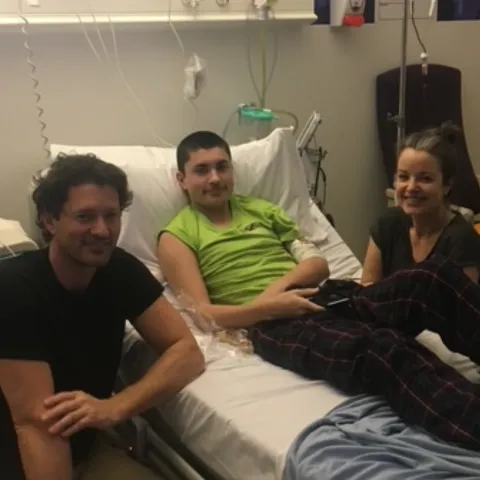
In April 2016, our youngest son, Ramsey, was diagnosed with, Philadelphia-positive acute lymphoblastic leukaemia. From that moment onwards, everything we knew as a family changed. What followed was two years of intensive chemotherapy in Spain, and then a bone marrow transplant in London in 2019. My husband, Khalifa, and I took it in turns at Ramsey’s bedside, alternating every 48 hours until we were too exhausted and had to go down to every 24 hours. Over the course of treatment, he was put under general anaesthetic 23 times. We learnt to feel his skin for fever, which is one of the first things you learn. You learn to stay alert, even when your own body is begging for sleep. There’s no 'off switch' when you’re caring for your child through such an intense experience. You live in survival mode. This medical protocol meant weeks, and sometimes months, at a time in hospital. To enable us to get through these endless days and nights we created healing spaces in his hospital rooms. We prioritised keeping everything super clean, often using essential oils where permitted, finding natural light where we could. We sourced bone broth and nutrient-dense foods and explored complementary approaches, like breathing techniques, and physical exercises both in and out of bed.
Writing about our experiences
After his transplant, our cancer nurse specialist, Filippo, asked me a question I’ve never forgotten. He wanted to know what we’d done that meant Ramsey could leave hospital early and, more importantly, not come back with a secondary infection. Up to 75% of patients develop a significant infection post-transplant. Ramsey didn’t. Filippo had seen the hospital rooms we stayed in, how we managed the space, and he felt it was something worth sharing. For seven years I’ve avoided writing about it. Procrastinated. I thought Ramsey’s story belonged to him and isn’t for me to tell. But Filippo’s question stayed with me and eventually I sat down and began to put together what would become ‘Step by Step: A Parent’s Guide to Caring for a Child with Cancer’. It’s not a medical book. It’s a practical, holistic guide, carer to carer, covering things like creating healing spaces, using food as medicine, building your support network, looking after yourself as the caregiver, advocacy, and emergency preparedness. All the things I wish someone had handed me on day one. It’s small enough to fit in a handbag, with note pages at the end of each chapter so you can write down your own questions and concerns to take with you when you see your medical team. I’m hopeful that something in it will be of help. Even one tip, one piece of advice, if anything in these pages can help one other family, then Filippo’s question was worth answering. I want it to reach families when they need it and give them something practical to hold on to.
Stepping back into the light
Ten years on from diagnosis, Ramsey, who is about to turn 25, is here. We’re no longer going to hospital for daily, weekly or monthly blood tests. For the first time since 2016, we feel 'off the leash'. After all these years, I’m only now just feeling that we’re stepping back into the world of light. I don’t know how long that takes, and it has taken us a very long time, but we’re getting there. If you’re reading this and you’re somewhere in this journey, I want you to know that you’re stronger than you realise. Trust your instincts. Be your child’s advocate. Look after yourself, too, learn to accept help when offered, and on the difficult days, take it a breath at a time. Step by step. Paso a paso.