Resilience

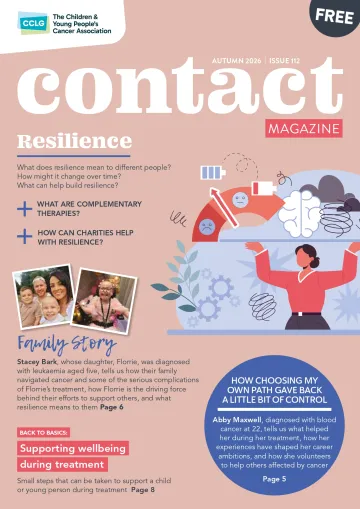
Resilience is tested throughout the cancer journey, but with the right support, it can be built and harnessed. It’s important to remember that resilience is not the same as being strong all the time, and you don’t have to carry everything alone. We hear from professionals and those with lived experiences who share advice and strategies that may work for you during the challenges you face.

Download this issue

Hello

Resilience is something that is tested at different points of a cancer experience. But how can you build and harness resilience, whether that be the mental, physical or emotional kind? Practising self-care, where you're able, can help, and so can using coping strategies. Taking small, achievable steps to improve holistic wellbeing, for you or your child, can also have huge benefits. Finding distractions or positive things to channel your time and focus into, and surrounding yourselves with the right people – and knowing when to ask them for help – is also important. And, as evidenced in this edition, there’s also a lot of charities and professionals who can help carry the burden. It’s important to remember that resilience and strength are different things. You can’t – and shouldn’t feel you have to – be strong all the time. But hopefully, with the right support, and by finding what works for you, you can adapt to navigate the challenges. 

Editor, Sam Chambers

Articles from this issue

Close up of woman's face with long brown hair

Ask the expert: Dr Olivia Walker

We ask the Clinical Psychologist what resilience really means during cancer treatment and share practical ways to protect your well-being.

A boy wearing a marvel t shirt and his mum wearing a grey vest and orange necklace sitting in a train

Why finding the right support for you is so important

Phoebe Scaife’s son, Barney, was diagnosed with bronchial mucoepidermoid carcinoma when he was eight years old. Here, she tells us why it’s important to reach out for, find, and accept the right support, and how this can help.

Young girl smiling at camera with pink coat and ginger hair standing in a park with autumn leaves in the bakground

Resilience, resourcefulness and a drive to help others

Mat Waugh’s daughter, Kirsty, was diagnosed with a brain tumour in 2024 when she was only 10 years old. Here, he explains how Kirsty has shown resilience through her determination and dedication to helping others.

A boy wearing a bike helmet standing behind his blue two wheel bike

Finding freedom on two wheels

Chris Badcock’s son, Sam, was diagnosed with a brain tumour in 2019 when he was 11 years old. He tells us how cycling made a profound difference to his son's recovery and quality of life.

Subscribe to our free quarterly magazine for families of children and young people with cancer

Subscribe to receive our latest quarterly Contact Magazine.