
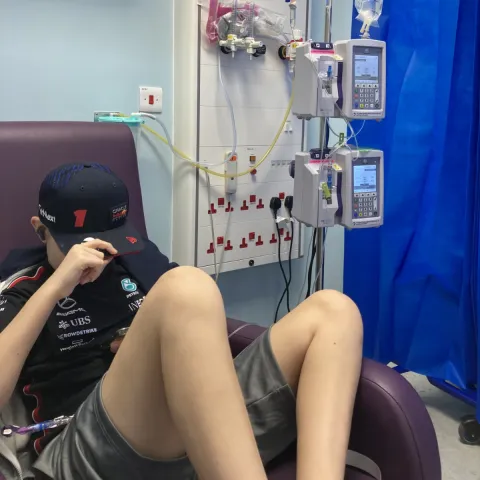
Around the end of March, Bertie had started getting headaches, which his school had flagged to us. He wears glasses, so we took him to the optician as we thought his prescription had maybe changed but it hadn't. As the headaches became progressively worse, we went to see a GP who felt at the time, it was maybe his age and hormones. However, they did say that because of the length of time they've been going on for, that maybe we should go to see a paediatrician.
We had private health insurance, so we decided to see a private paediatrician who diagnosed Bertie with migraines. However, his teacher at school kept saying they didn’t think this was right, that he didn’t think it was migraines. And it wasn’t just the headaches, he had really low energy compared to usual, and he wasn’t wanting to go out to play, but choosing to go to the library instead. This wasn’t like him, so his teacher was convinced there was more to it. Despite telling the paediatrician about his tiredness, he still put it down to migraines, saying that if someone had migraines, they would be tired. He was having night sweats which we later a found out was also a symptom.
Shortly after this, he fainted one day and ended up in A&E. The doctors there asked if we would see one of their paediatricians as they also didn’t think this was just migraines. They asked if we’d see their new neurologist but said we’d have to see their paediatrician first. We agreed to that because of the concerns his teacher had. From there, they sent him off for a blood test but didn't say it was urgent. He had his SATS coming up in school the following week and the only appointment I could get which wasn’t going to interfere with his exams was on his birthday.
So, we took him for his blood test, and then he celebrated his birthday, having a lovely time with his friends. Then, about 10:30 that night, we got a call from St George’s Hospital telling my husband, Richard, and I to get him there straight away. We got him there straight away, and when we did, he was taken straight into intensive care.
They told us that they thought he had leukaemia, and that it had caused his potassium levels to go sky high, so he was at high risk of cardiac arrest. If he was diagnosed any later, had that blood test later, Bertie might not be here. He might not have had the chance to fight the leukaemia at all. It could have been a very different story.
Just three hours before his diagnosis, Bertie had been wrestling in the garden with his friends, having birthday cake. Life really does just change in a blink of an eye. One minute everything's fine and the next minute your world comes crashing down in a way that you can't possibly imagine.
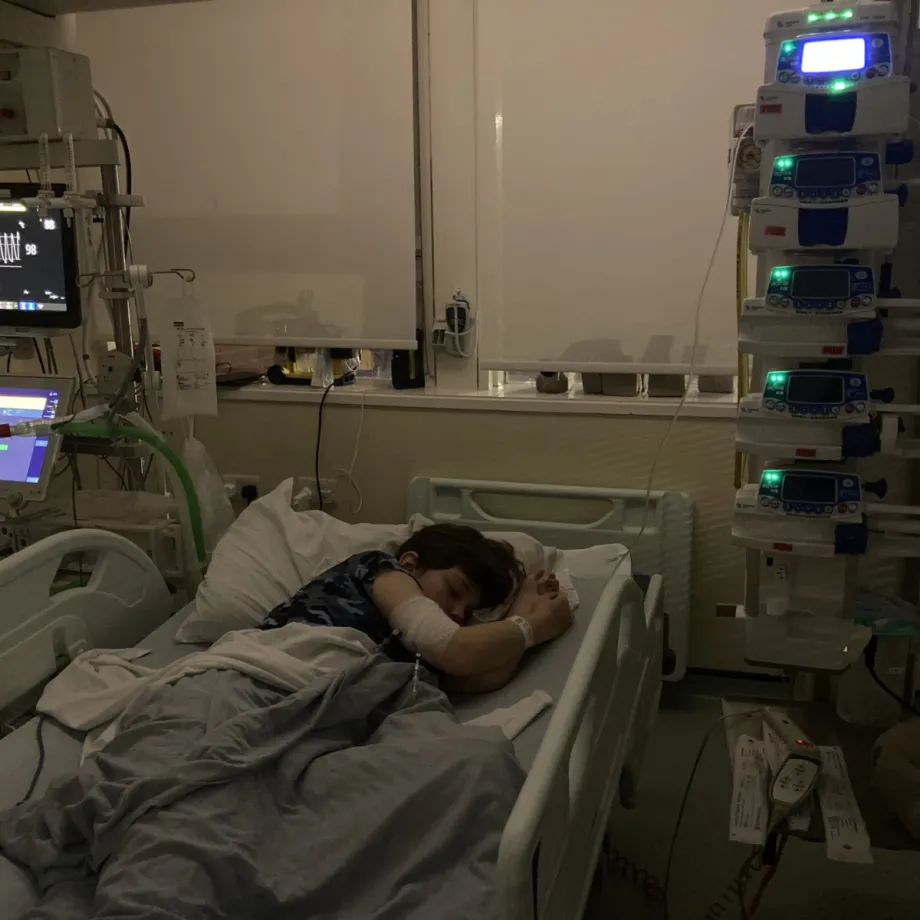
Bertie in hospital
Bertie’s treatment: The challenges and support
Bertie’s treatment lasted 25 months and was really tough for him. Frontline treatment was incredibly intense. Bertie was really isolated from his friends, and he really struggled with sickness. He was very, very sick throughout it. He was sick almost every day, sometimes multiple times a day, for the first 14 months pretty much, and often, he ended up in hospital for rehydration. At times, he felt so ill he just wanted it all to stop.
In frontline treatment, there were quite a few blood transfusions and platelet transfusions. Every Monday he had a blood test and if his haemoglobin or his platelets had dropped too low we would get a phone call asking him to go in for a transfusion.
Bertie was diagnosed at a time when his friends were transitioning from primary school to secondary school, too. There was a lot of end-of-year excitement, with trips and parties going on, which he physically didn't have the energy to take part in. He was also losing his hair at that point, which I think was a real struggle for him because he was physically changing as well. His face had blown up quite considerably from steroids, and this was really hard for him. He didn't want people to see him.
Bertie’s education was also affected by his treatment as we made the decision along with his primary school and secondary school to hold him back a year. We wanted to give him a year where he didn't have to worry about keeping up, making new friends, having to deal with that transition. Initially, he was distraught with that, and I think it was tough seeing all his friends moving on and him not being able to do that. But if you asked him now, I think he’d say he understands why we wanted him to start secondary school a year later when he'd finished frontline treatment.
His best friend has been amazing and been an absolute rock through thick and thin. Without him, I think it would have been even tougher for Bertie, but they’re still so close despite being at different schools and in different years.
Throughout it all, we’ve seen great support and care from a whole range of people. Momentum Children's Charity has been brilliant, while both hospitals Bertie has been treated at, St George’s and the Royal Marsden, have been incredible. My work has been brilliant, too, and we're very lucky that we've got a very close network of friends around us so that live very close to us locally.
Finishing treatment
Bertie finished his treatment in June 2026. He’s really pleased to be finished, but I think he was also quite nervous about finishing. I think he feels like he’s had the security blanket of the chemo whipped away. But equally, he's quite looking forward to sort of some ‘normality’ in life again. He’s back at school now and I think looking forward to things to feel like they can move on for him.
Why research is so important
Bertie has only got to where he's got to because of all the research that's happened prior to him being diagnosed. Things have got to a point where they've improved but it could be so much better. There's so much more to think about now, not just life-saving treatments but how to make those treatments kinder.
I think that was something we weren't really aware of before Bertie was diagnosed – we weren’t really aware of anything about childhood cancer before then – and how we need to find new treatments that are built for a child’s developing body, to lessen the impact they have to live with for the rest of their life.
We're really grateful to the likes of CCLG who fund research and the people who conduct it because without it, Bertie might not be alive today. That’s why we’ve fundraised for the charity, to help others diagnosed in the future.
My advice to other families
Early on in Bertie’s treatment, we were told by somebody to try to keep life as normal as possible, which is what we did, and I would tell others to do if they can. Your world isn’t normal anymore and has been completely shattered, but I think keeping positive and striving to do as many things as possible when your child is feeling well really helps. With us, that gave the Bertie goals to work toward, and I think that was really important. Even if it's just little things or adapting what they can do. You could say: “You’re missing out on this, but how about we try and do this instead?”
On one occasion, one of Bertie’s friends had a cinema birthday party when his neutrophils (white blood cells) were really low. It wasn't sensible for him to go into a packed cinema full of people, and he was really upset about that. So, instead, we did a movie night at home with three of his friends a week later, which was really nice. Having little goals of things to look forward to like that was really helpful. It’s not always easy to do so, but I think trying to do these things and thinking positively really helps.
Another piece of advice I’d give is take up people up on any offers to help. People do want to help and feel useful as well. Friends and family are your best support network, so even if you feel like you don't want to be a burden to them – which you’re not – do accept their offer of a cooked meal or helping with siblings. It’s their way of contributing.


